Skip to content
  • Home
  • About
  • Books of the EthiaVerse
  • The EthiaVerse Codex
  • Frequently Asked Questions
  • Writing Coaching & Mentoring
  • Blog
  • Book Reviews
  • The Writer’s Toolbox
  • Contact

The EthiaVerse

  • The Passive Voice

    March 24th, 2012

    Everyone talks about passive voice, but what is it exactly? How can it be made to work to benefit a piece of writing and when should it be avoided all together? When is a piece too passive? 

    Passive voice occurs when the subject of a sentence is neither a do-er or a be-er. The subject exists, but not focused on. The real emphasis happens- when it is the most important- to the thing acted upon, or when the actor is not important.

    Example:
    Acted upon… The man was found on the side of the street.
    Actor not important… The valley can be seen best from the top of the mountain.

    In these cases passive voice works and is beneficial to a piece of writing, however, there are many times when passive voice is used and it shouldn’t be used at all. This usually happens a lot when the passive voice is used to avoid responsibility for actions taken.

    Example:
    Passive… The Native Americans were forced onto reservations by the government.
    Active… The government forced the Native Americans onto reservations.

    Passive… A letter is written.
    Active… Josh writes a letter. OR… Josh wrote a letter.

    Passive voice is created by combining a form of the “to be verb” with the past participle of the main verb. Sometimes other helping verbs can be present as well: “The house could have been burned to the ground by the fire.”

    Formula of passive voice…

    S + (be) + past participle

    The house was designed just for her.

    Example of some “to be verbs” are: was, were, is, are, has been, have been, will be, is being, and are being. A full listing of these verbs and more examples of the passive voice can be found at ego4u.com.

    When is a piece of writing too passive? Just skim through and see how many of the “to be verbs” hit you in the eyeball. In my pieces, I usually find an overabundance of was, has and have been, but everyone is different. It usually helps to highlight them in yellow to get the full effect, which also leaves you with a whole new appreciation of the passive voice.

    For more on the passive and active voice you can check out some of these helpful websites…

    • More examples of passive and active voice examples can be found at… ego4u.com
    • Myths of passive voice and full definition can be found at… The Writing Center of UNC
    • A video explaining what passive voice is… The Passive Voice YouTube video
    • Take the passive voice quiz! Test you your knowledge of the passive voice here (scroll down the bottom of the page to take quiz)!
  • Want to Be More Creative? Bring Out the Inner Child

    February 21st, 2012

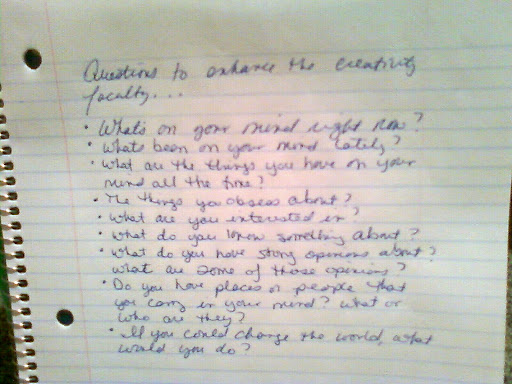
    Let’s face it, creativity is the bread and butter of being a writer. It’s the spark that gets the imagination going and is an essential part of coming up with something interesting to write about. It would stand to reason, then, if a writer has trouble coming up with ideas for writing, what a person really might be having problems with is creativity. This problem can be fixed by bringing out the inner child that resides in all of us.

    Be a child? Oh, yes, Be a child. Act like a child. Think like a child. Why? Because children are some of the most creative individuals out there. I know this because I have a four year old and I love watching him play because his creativity is so fresh and unencumbered by the restrictions of adulthood. If I need inspiration to write or come up with new ideas, all I have to do is spend some time with my son, and every time I come away with insights I’d never considered before.

    The thing what floors me is that these insights are usually so simple and obvious, but most adults (like myself) are too busy to see the simple anymore, though, it’s not just the simple, but really the incapability of looking at things from a different point of view. Sometimes creativity can be sparked just by breaking the brittle rust from our own minds and allowing us a change of view. It’s about having an open-mindedness to embrace new ideas no matter where or how they come, just as a child is naturally programed to do.

    It’s a big scary world out there and it’s full of stuff that needs to be done right away. This often has a person running like crazy, or simply consumed by the day-to-day issues that hampers all adult lives. It’s no wonder with all the bill paying, job responsibilities, laundry folding, and rushing kids back and forth to school and soccer practice that the inner child disappears all together to be replaced with a mask of constant responsibility. This mask can be difficult to take off and sometimes it’s just downright inconvenient to do so. Other times, the responsibility of adulthood has consumed a person to the point of no return and the thought of being “child like” is repulsive.

    When I have creativity “issues,” I have to remind myself to stop being so serious and let the mask of responsibility be put away from time to time, allowing for something that is so incredible as letting the inner child take control. It’s a freeing and satisfying thing to let happen, and it can do wonders for a mind of stone. Letting the inner child time to play, will loosen up that stone, which will then, morph into a waterfall of ideas that may even be difficult to contain.

    Need some ideas on how to access your inner child? Swing in that swing on the playground, dance in the rain, build a sandcastle, eat ice cream with gummy bears, and if you don’t have a child, then borrow one. Get down on their level and play for awhile. If you’re like me, you’ll be amazed at what you discover, and might find yourself inspired to do something never before considered. Just make sure to keep a notebook handy to write down the sparks of creativity, as you let the inner child play.

  • More on Focused Free Writing

    February 11th, 2012

    As I already discussed in The Amazing Benefits of Free Writing, practicing free writing on a daily basis can open up writing in a wondrous way. This happens in the best way possible when free writing is focused on a specific topic or question. The topic or question can be anything that you chose, but the more specific the question the better. Having a broad topic to work on can be more confusing than helpful, but allowing freedom to explore inside a narrowed topic or question allows for discovery that might be surprising and quite enlightening. Here’s how I do it…

    I like to make a list of things I want to know more about. When I have the time to sit down to write, I chose one from my list to write on. I let the pen take me to where it needs to go. I give myself permission to go beyond the borders of my chosen topic, but only if I think it will help fill in the blanks of the subject at hand. Any stray thoughts that have no relation to the writing “topic” is put in the margins of the paper, so I can come back to it later. At the end of the focused free writing practice, I often find myself surprised at what I come up with. The point is to be flexible enough to explore an idea fully, but not to go off the path so far as to be nowhere near the first original idea. It’s a delicate balance that can only be found through lots of practice.

    Not sure where to start in focused free writing? Look at your own work. Do you have questions about the story, the characters, the plot, the ending, the beginning? Do you have questions about a certain topic in your story? Or maybe you have questions about where your writing journey is going? Do you have mixed feelings about the contract deal you’ve just been offered for a new piece of work, or whether to attend a writing conference, or maybe the question is as simple as trying to figure out the optimum time of day to write?

    Focused free writing can be beneficial, because it offers a deeper look into current and future writing projects, or even into the actual writing journey. Sometimes just the act of writing out a problem can give a solution that has been illusive for days or weeks. Most often, it is during this act that allows a writer to stumble across solutions never considered before.

  • The Amazing Benefits of Free Writing

    January 13th, 2012

    There are many tools in a writer’s toolbox, but none is as helpful as the simple practice of free writing. It’s something that I picked up in my writing journey, which I used––but never fully appreciated––until I learned how powerful it could really be. This happened after reading the book How to Be a Writer by Barbara Baig.

    Nearly all her exercises, in the 265 page book, uses different variations of simple free write and focused freewriting. After doing several of the exercises, I found that all the free writing I’d done up to that point was really just a warm-up. I never took it to the next level, because I hadn’t realized I wasn’t doing free writing nearly enough (it should be done everyday), or even asking the right questions to do focused free writing.

    Free writing is a remarkable tool that has, in a short period of time, led me to amazing discoveries about myself and my writing. The act of writing my thoughts directly onto the page, without any censorship, has given me the ability to articulate things that I wanted to say, but never knew how to say. It even unearthed things I never expected, and has led me down an entirely new path of writing, which I never would have seen without the process of free writing.

    What is free writing and how does it work? It is actually a very simple process of writing either with pen and paper, or computer––whichever you feel more comfortable––for at least ten minutes without stopping (I use pen and paper because I find it’s easier to let go of the editor and just write). Turn that inner editor off! Don’t erase or correct mistakes! Keep writing no matter what! Set a timer, or an alarm if you want to keep the free writing limited in time (at the very least do ten minutes, if not more).

    If you run out of ideas to write about, then just keep writing, “I don’t know what to write now,” until something pops up. Believe me, once you let the gate open, a flood of ideas will hit and you might even find it difficult to stop. I usually want to keep going, but have to move on to something else (but will come back later to explore more). Other times, I find that I’ve exhausted my ideas, and move then on to another subject to free write on, or another writing project all together.

    The beauty of free writing is that you can free write on anything you chose. It can be a journal; a way to help get rid of the random thoughts, or the list of things you need to get done that day, or an argument you just had with the next door neighbor––or what I like to call “junk”––filling your head any given day. Once that junk has been expelled, other ideas are free to float to the surface.

    The free writing can be on a specific subject or topic you want to write about. It can be on a new character that’s been haunting you. It can be, “I don’t want to do this” over and over. It doesn’t matter. Keep the pen moving! The point is to let yourself go and see where it takes you.

    In doing this, you may wander into territory you don’t want to touch on, so change the direction. You may even find something new to explore that you never considered before. It’s up to you where you go and how long you want to go there. Just don’t have any expectations for your writing and allow yourself to enjoy the journey. You are in control!

    The most important is to keep any free writing you do private. This gives you the freedom and you need to explore without judgment from others. The pressure is off and you no longer feel like you have someone looking over your shoulder. It is just you and your thoughts. Doing this will eventually boost your confidence as a writer, and will also let you just practice being a writer.

    As important as it is for others not to judge your work in this practice stage, that goes double for yourself. If you find what you are writing “terrible” or “wonderful”, just ignore it, and move on. There will be plenty of time later to decide to polish up an idea, or just dump it all together. Right now, all that matters are the words being poured onto the page. Those elusive words and ideas are no longer hiding inside your crowded mind, but in solid form ready for you to use in any matter you chose. So keep that pen moving, and let the ideas flow!

    Check out More on Focused Freewriting to know more about the free writing process.

  • Publication: Why the Rush?

    January 5th, 2012

    There are two kinds of writers; the ones who are published and the ones who are not. The ones that are published are constantly looking for new things to write about and launch into the world (they make it look so easy). Then you have the writers who aren’t published, looking at the published authors and saying, “that’s what I want.” So these unpublished or newly published writers race to break into the field, because it’s what’s expected of them.
    What is the first thing that people say when you tell them you’re a writer? I usually get, “Make sure to remember me when you become the next Steven King (or whoever)?” Or if you talk to a friend or family member you haven’t seen in awhile, “So when’s that big novel coming out? Did you get it published yet?” It’s all about the rush to be published to get your name out there, because if you can’t justify your writing by publication, then are you really a writer at all?
    Interesting that writing has such a push to get results when other pastimes don’t (usually) get that sort of attention. Do your friends ask when you’ll be the next Emerald or Michael Jordon? Do they wonder when you’ll try out for an Olympic team or become the next Picasso? Why the rush?
    Why can’t you take the time to make your writing better? What’s the big rush? Do you really want to look back five years from now and say, “What the hell was I thinking publishing that?” Wouldn’t it be better to slow down and make sure you get it right? Good writing cannot be rushed and great writing can only happen when you let it. Just because the piece is “okay” doesn’t mean it should be rushed to the presses for the world to see. Do you really want to be known as an author with just okay stories- or worse?
    There are some people (and I know this from experience) that have stories they’re just tired of writing on. A burning desire deep within to get something published makes the rash decision that the piece is “good enough” and sends it out knowing the story could be better- much better. Why the rush?
    I have come to the belief that all good things come to those who wait. Those who take the time to make themselves great instead of putting stuff out there and then regretting it. Once a piece of writing is published, it’s out there- forever. There is no going back, no do overs. It’s immortalized in black and white, so why run the risk of having a black mark on your writing resume when you can take your time. Why the rush?
    You might be thinking, “Yeah, everyone thinks that way about their work.” Maybe, but wouldn’t it be better knowing that your best foot was put forward, instead of a hurried rush to get to the finish line? I have certainly felt that way about some of my work and have decided that my time means more to me than that and I want do something more worthwhile.
    Then you’re thinking, “But if you wait until that happens, you’ll never get anything published.” Maybe, maybe not, but again do you really want something that you aren’t that proud of immortalized in print when you know deep down that you can do better? Why the rush?
    Why is it so important to be published right now? Unlike many things in life, writing is one of the areas that you have complete control over. You control when you writer, what you write and what you let the world see. Next time that burning desire comes over pushing to send a story out before it’s really ready, just ask yourself… Why the rush? Why not spend a little extra time getting it right?

←Previous Page
1 … 38 39 40 41 42 … 45
Next Page→

Proudly powered by WordPress

Loading Comments...