Skip to content
  • Home
  • About
  • Books of the EthiaVerse
  • The EthiaVerse Codex
  • Frequently Asked Questions
  • Writing Coaching & Mentoring
  • Blog
  • Book Reviews
  • The Writer’s Toolbox
  • Contact

The EthiaVerse

  • The 3 Acts of Story Structure

    February 1st, 2013
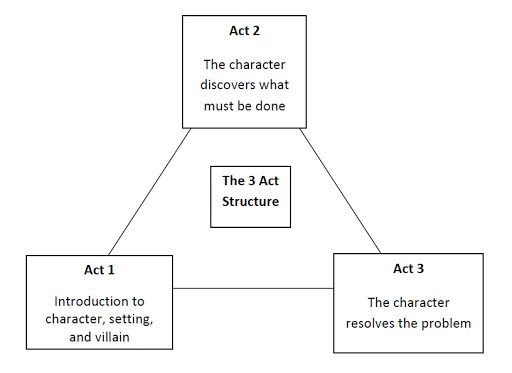
    In the recent writing workshop with Johnathan Maberry we talked a lot about the 3 acts of the story structure. This workshop made me realize once again how helpful this little tool can be when plotting out a story. Most stories can be broken down to this basic structure and it is something to use as a guide when plotting out your own story. Let’s break down the 3 acts and see what each act entails. I’ll also use an example of the Wizard of Oz to show this breakdown.


    ACT ONE it is the introduction of characters and setting, possibly a glance at the villain and an introduction to the threat within the story.

    This is where all the reader needs to become familiar with the character and become invested in the story that is unfolding. The world needs to be established

    END OF ACT ONE happens when the character reaches the point of no return.  He or she is propelled or pushed forward into the story and the character’s path is set

    Example: Dorthy is introduced into the story. We see that she is a young girl who is spoiled and untested. A tornado whisks her away to the strange land of Oz.


    ACT TWO this middle act usually takes up about 50 percent of the story as the character is further developed and the stakes become clear.

    This is where relationship building happens between the main character and the supporting characters, and it’s were subplots usually take place (for novels or longer short stories).

    END OF ACT TWO happens when the character realizes what must be done to resolve the problem that he or she has been faced with.

    Example: Once in Oz, Dorthy meets Glinda. She tells Dorthy what must be done to go home and Dorthy sets out on her mission to find the Wizard of Oz.


    ACT THREE is when the character finds the resolution to the problem.

    This is where the character rises above everything in his or her path to be the story’s champion.

    END OF ACT THREE happens once the character resolves the main issue of the story either for the good or bad.

    Example: Dorthy defeats the wicked witch and finds the Wizard of Oz.


    Now it’s true that the 3 act applies mostly to screen plays, but it can also be applied to most stories as well. Sometimes the acts are expanded to create more than three, and sometimes the first act is combined with the second act in stories, but using the three acts can help to show the skeleton of a story. It’s a good simple way to make sure a story is on the right track to creating a coherent and dynamic piece of work. If you haven’t already, can you break down your current piece of work and find the 3 acts of its structure?

    There are also those who argue that a 3 act structure can’t show all the elements of a story that it really takes a 5 act structure. This type of structure just breaks down the story even further with exposition, rising action, climax, falling action and the denoucement or resolution. You can read more about in a post that I wrote a while ago about Freytag’s 5 act structure.
     

  • Book Review: Dark Faith Invocations

    January 20th, 2013

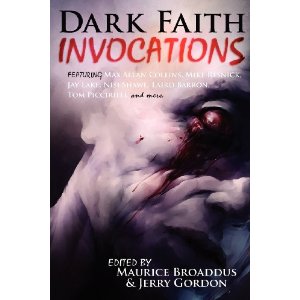
    I am currently reading an anthology that I’m just loving and thought I’d share. Dark Faith: Invocations an anthology of 26 stories with authors like Tim Waggoner, Max Allen Collins, Jennifer Pelland, and Tom Piccirilli. These stories test the faith and expose the soul as they delve into the world of giant Buddas, human machine robotnicks, a man renting an apartment in God’s head, the cost of expelling one’s soul, and so much more. Reading each story is like opening a brand new shiny treasure of deep characters, strong emotion, and beautifully crafted worlds.

    You can also join me and others as we spending the next few weeks discussing each story on Goodreads. I’ve been enjoying the chance to chat with others about these remarkable stories. It’s been a fun and enlightening experience as I get a chance to hear other people’s impressions and have the opportunity to share mine.


  • Book Review: Between the Lines

    January 5th, 2013

    Between the Lines by Jessica Page Morrell was highly recommeded to me by other fellow writers, but I only recently purchased and read it. I wished I’d done it sooner. It’s a wonderful book that really dives into the more subtle elements of fiction writing. It’s already in my favorite book category, and I’ve only read up to chapter 8 so far.

    This book is all about honing the blending and balance of words and structure to create a superior piece of work. Some of my favorite chapters consist of topics such as; what to do about backstory, epiphanies and revelations, foreshadowing, and imagery. These chapters has already changed the way I approach my writing, and I’m especially looking forward to reading the other topics, which includes (but not limited to); pacing, sensory surround, and subplots.

    I love that this book goes into topics you can’t really find in other writing books, and if you can find it, the topics feel rushed. In Between the Lines, Jessica Morrell takes the time to break down each topic until it’s quite understandable. If you are looking for a way to give your writing that shining polish and deeper meaning, this is the book that will help you get there.


  • The Truth About Flashbacks

    August 1st, 2012

    This post is another result of one of Michael Knost classes. This most recent class I took was all about flashbacks (and backstory, but that’s a different post). I found a few “light bulb” moments in the class that just had to share, but this post really is only the tip of the iceberg of what I learned.

    The most important thing to remember… Flashbacks should not be used unless there is absolutely no other way the story can be told. Flashbacks carry a built-in disadvantage to even the best of written stories, because it stops the story. A flashback is about something that has already happened. It’s over and done with so the flashback lacks immediacy.

    There are 3 advantages to having a flashback in a story…

    • helps establish character motives
    • fills in events of how the original current story came about
    • fills in critical information that happened years earlier

    If a story must hold a flashback there are 3 ways to maximize the advantages of a flashback…

    1. Time travel done right
      Every flashback should follow a strong current story scene. Flashbacks should never start a scene. Before dropping the past onto the reader, the current story must be established first; otherwise, the reader will become invested in the flashback and not care about the current story.
    2. Orient the reader at the start of the flashback in time and space
      Make sure that it is made clear that the story is moving backwards in time. Give a clear indication at the very beginning what is happening to avoid throwing the reader into confusion and frustration. There’s nothing worse than reading a story and not being able to figure out where in space and time the story is supposed to be taking place.
    3. Use verbal tense conventions to guide the reader in and out of the flashback
      Conventions through verbal tense can be used to “signal” both the start and end of a flashback. This sort of thing is subtle and may not be noticed by the conscious mind of the reader, but is very effective in guiding the reader properly in and out of flashbacks. This is the best way to help eliminate flashback confusion.

    Example: Let’s say you are writing a story in pasted tense (that’s my preferred style of writing). That means the first few verbs (usually the first 5 verbs) used in the flashback should be perfect past tense (had, had been). Then switch back to pasted tense. When you are ready to end the flashback switch back to perfect past tense for another 5 or so verbs. Once back in the current story, you return to using past tense verbs.

    Are you confused yet? Here’s a shortened version I made to help me keep it straight…

    current story (past tense) + beginning of flashback (perfect past tense 5 verbs) + middle of flashback (paste tense) + end of flashback (perfect past tense 5 verbs) + return to current story (past tense)

    What if a story is written in present tense? Then you would use past tense verbs instead of perfect past tense verbs.

    Here’s an example of a switch from a present tense story to flashback from Suzanne Collin’s Hunger Games...

    “We don’t speak. Our real interaction happened years ago. He’s probably already forgotten it. But I haven’t and I know I never will…
    It was the worst time. My father had been killed in the mine accident three months earlier in the bitterest January anyone could remember. The numbness of his loss had passed, and the pain would hit me out of nowhere, doubling me over, racking my body with sobs. Where are you? I would cry out in my mind. Where have you gone? Of course there was never any answer.”

    If flashbacks are used, it should be done sparingly. Flashbacks should never occur back to back. Strong scenes should separate each flashback scene.

    There is an acceptable form of story that uses flashbacks to tell a story and that would be a “frame story”. This story can be any length (from short story to novel), which begins after all the action is over. The protagonist or author announces that they are going to tell a story and may even give out the entire outcome at the beginning of the story. Example of this type of stories are True Grit by Charles Portis and Water for Elephants Sara Gruen.

    Update June 26 2019: I wrote this blog post many years ago, since then my position on flashbacks have changed. I do believe flashbacks can be used as often as a person wants within reason. I published my first book Blood Feud and it has numerous flashbacks that, in my opinion, work very well. But I spent a lot of time trying to get them right and making sure they were necessary to move the story. Sometimes in order to move forward and bring more depth to a story flashbacks can be quite useful.

    It is also worth mentioning here too, that just because a writer gives you advice on how writing should be, does not mean it has to be. Use your best judgement. Every writer and every story are unique. Know what is true for you as a writer, and let the rest go. Happy Writing!

  • Using Body Language to Tell Your Story

    July 11th, 2012

    I recently took an online class through my friend and fellow writer Michael Knost on body language, and wanted to share some of the highlights that I found helpful. This was a topic I knew some about from other writing sources, but his class really brought everything into prospective for me.

    Body language is essential in creating believable characters. It’s the subtle things like a smile in just the right place of a conversation, or a small touch of the hand that can change the whole way a reader perceives a character. When you show a character through their body language, you are allowing the reader to size up the character without spoon feeding information that might push the reader from the story. The reader wants to feel intelligent as he or she comes to their own conclusions. It’s the writer’s job (you) to be invisible enough to help lay out the signs or clues that get the reader to where you want them to go.

    Check out some of these statistics…

    55% of communication consists of body language
    38% is expressed through voice
    7% is communicated through words

    Yeah, I was kind of shocked by the only 7% is communicated through words. Kind of made me feel small and unimportant with all my writing, which then made me realize that it’s all in how you express those words. That’s the key ingredient to really great writing. So my next thought was… how do my own characters express themselves?

    There are 4 major ways for a character to use body language to express themselves…

    • Facial Expressions
    • Gestures
    • Body Posture
    • Space

    What are the eyes of your character saying? Is your character fidgeting from boredom or restlessness? Is your character sitting forward to soak up everything another character is telling them? Or is your character in someone’s face for something that made them angry?

    Also consider this… does your character’s actions match their words? Readers will believe body language and tone over what someone says. If a character says they’re open to a new idea, but crosses their arms or turns their body away, what the reader really sees is a character who is closed and rejecting the message, but not willing to admit the truth. This sort of “mixed signal” can be used to add to the character, or story. It can also take away from the character and story, if not done correctly.

    When using body language it usually helps to build it up to a series of actions, because some body languages (like smiles, fidgeting, or no eye contact) can mean several different things. Writers should give about 5 clues within a scene to show context of an emotion (through body language) without coming out and saying it. This will help lead the reader to make his own conclusion.

    Body language is your character. Make sure that that all body language is important, if it isn’t, cut it out. Also get rid of overly used gestures, or body language like… she sighed or he winked. Find new or better ways for your character to express themselves. Remember that too much of a good thing can tip your hand to make the writer visible to the reader. Great writers disappear as their story comes alive.

←Previous Page
1 … 37 38 39 40 41 … 45
Next Page→

Proudly powered by WordPress

Loading Comments...