Skip to content
  • Home
  • About
  • Books of the EthiaVerse
  • The EthiaVerse Codex
  • Frequently Asked Questions
  • Writing Coaching & Mentoring
  • Blog
  • Book Reviews
  • The Writer’s Toolbox
  • Contact

The EthiaVerse

  • Dig a Little Deeper

    March 5th, 2011

    Are you stuck and not able to move forward in your writing? Do you find that no matter what you do those words just won’t come, even when you bang your head up against the wall? Are you feeling completely abandoned by your muse and not sure he or she will be making an appearance ever again? Then it just might be time for you to dig a little deeper.

    Writing blocks come for many reason:  a lack of material, a lack of direction, overwhelming pressure to complete a task or project, personal issues that remain unresolved and fester, lack of creative stimulation, and self-doubt. All these things and others can cause a person to shut down and not be able to move forward in their own lives and in writing as well. If you are like me, your writing is connected to your emotions, so if you have any sort of emotional upheaval or emotional decline, writing becomes difficult, if not impossible. Here are some ideas you can use to work through this creative slug and find your way back to the light.

    First of all, write even when you don’t feel like it. The nature of writing itself will lift you up- that is if you write about something uplifting. As you place words onto the page, you are tapping into that eternal spring within (yeah, it’s there even when you think it’s completely dry), as you dive into it you become transformed by those words. Write happy and you will be happy. Write sad and you will write sad. Write contemplative and- well, you get the picture.

    Get those creative juices flowing by surrounding yourself with creative, stimulating things. What inspires you: music, art, candlelight? Also change your venue where you write. Do you normally write at home in your office then try writing in the kitchen, in the living room. Take an afternoon trip to a coffee shop, the library, or take pen and paper out and let Mother Nature spark those creative thoughts.

    Another great way to try moving over roadblocks of creativity is by doing writing exercises. It can be as simple as setting a timer and writing none stop for ten minutes or as elaborate as buying books with writing exercises and using that. It really doesn’t matter what you do as long as you write. Doing the exercises will break loose the dirt clogs stuck in the mind and sprout a garden of new ideas. Do it every day and you’ll be amazed by the results!

    Still feeling the glum of that block pressing down on your shoulders? Try digging a little deeper. What do I mean by that? Pick a topic that is personal, one that elicits strong emotion and write about it. You know what I’m talking about. It’s a topic you may not talk about or simply ignore because it’s too uncomfortable to go there. Dive in headfirst. Don’t think twice about it. Just write. Go where you’ve been holding back. Just let it fly and see where it leads. Chances are you will not only come up with a multitude of ideas for your writing, but you may very well make some key discoveries about yourself as well, so don’t hold back and just dig a little deeper.
     

  • Starting Your Story: Beginning in the Middle

    February 23rd, 2011
    The blank page stares back at you, mocking your very effort of telling the story that’s been haunting you for days, but where should you begin? You know that there is a masterpiece of character and plot just waiting to erupt into written form, though at times it can be a challenge to figure out exactly where the beginning really should be. The best place to start is in the middle.
    In the middle of where, you ask? – The middle of the action. Throw your reader in head first right in the middle of something going on. It can be as dramatic as a high-speed car chase or as mundane as washing the dishes, but the point is to have your character actively living out their lives. Then you can spend the rest of the story catching the reader up to the important information they need to know about.
    The story can begin with narrative summary, description, dialogue; whatever, as long as the reader becomes hooked from the very first sentence, so he becomes sucked into your world instead of putting down the story and finding something more interesting to do.
    That is why beginning sentences are so very important. If you can’t catch a reader’s attention at the beginning, then chances are they will never make it to the end. Here are just a few examples from some authors who have managed to do just that!
    The gale tore at him and he felt its bite deep within and he knew that if they did not make landfall in three days they would all be dead. Shogun by James Clavell
    Whether I shall turn out to the hero of my own life, or whether that station will be held by anybody else, these pages must show.  David Copperfield by Chares Dickens
    I answered the phone, and Susan Rodriguez said, “They’ve taken our daughter.” Changes by Jim Butcher
    I’d never given much thought to how I would die- though I’d had reason enough in the last few months- but even if I had, I would have not imagined it would be like this. Twilight by Stephanie Meyer
    Sometimes writers, especially new ones, have a hard time beginning a story and struggle with how to present their story, because they do not know how the story will end. Don’t let this hang you up. If you begin with a good idea and have real characters then something wonderful is bound to happen. In fact, not knowing the end will make the journey of discovery that much more meaningful for you and will lead to places you may never have considered otherwise.
    It’s the first words that you write that draws a reader in and hooks them, leaving them wanting for more. If you can’t do that with in the first few paragraphs, even the first sentence, you have already lost your audience, so you should practice the fine art of creating your own beginning sentences.
    Try writing five of your own beginning sentences for five completely different stories. Put them in a journal or somewhere you can go back to later. Then add another beginning sentence everyday for the rest of your life. This will not only get you in the habit of writing everyday, but it will also give you some great practice writing beginning sentences, which will in turn, become a treasure trove of  new story ideas for the future.
  • The Building Blocks of Plot

    February 22nd, 2011

    I recently became aware of a detrimental flaw to my works of fiction to find myself unable to complete many of my stories. I began to realize that my problem laid with my fundamental understanding of plot and so I decided to dive into research to try and find a way to fix this problem. During my journey that spanned over two months, I found a lot of helpful information and began taking notes- lots of them. I then decided that there may be others out there with my same problem and so began to write an article on plot, but there was a problem. There was way too much information to fit in a 500 to 700 word article, so I began a series of articles. Then a friend of my suggested putting the articles together to create an ebook, so here is the finished product of all that effort. I place it here for those who would like to read it. Hopefully you too will find some use for it. It certainly isn’t a full comprehensive about plot, but it will at give you an idea of what good plot is and how to use it to get that story out from start to finish!

    I have the free ebook posted on Google Docs. You can download it below.

    The Building Blocks of PlotDownload
  • A Breakdown of Plot Diagrams

    February 2nd, 2011

    Download PDF file here.

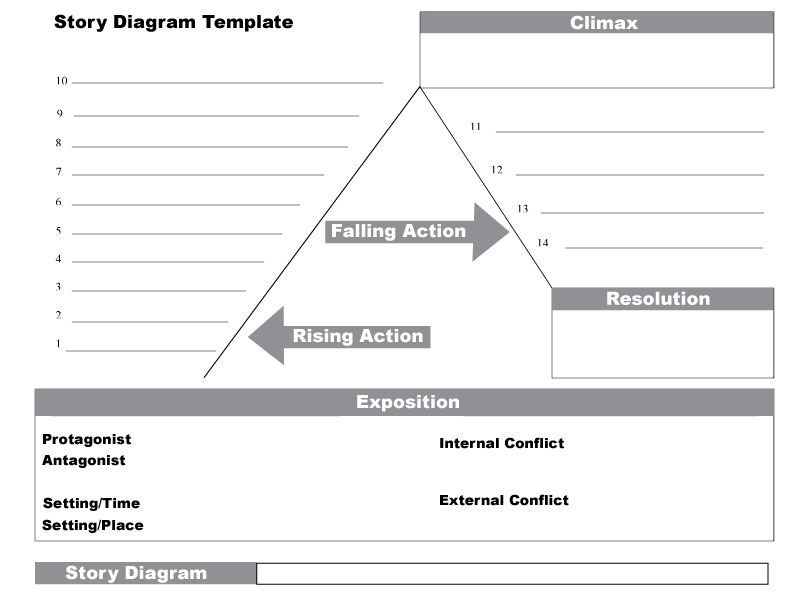
    Plot diagram is also called the structure of the story. It is the main outline of what is going on and everything else exists solely to support that structure. There are a couple of different types of plot structure that can be found but the basic one consists of Exposition, Rising Action, Climax, Falling Action, and Resolution.

    Exposition sets up the story and lets the stakes become known.

    Rising Action is the problem and/or conflict the character attempts to resolve.

    Climax is where the story is at its worst.

    Falling Action is where the character begins to solve the problem.

    Resolution brings the story to a close in some manner.

    Download PDF file here. 

    Exposition, Rising Action, and Climax (or beginning, middle and end) is what is called the 3 acts of a story, each plays an important part to the story.

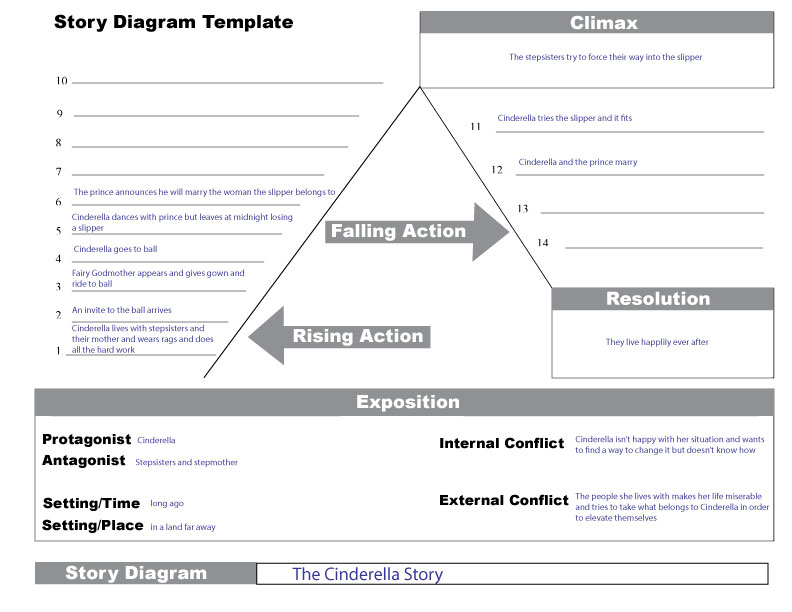
    I took the Cinderella story and broke it down into the five stages to make it even more understandable.

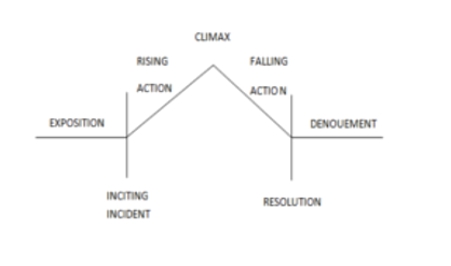
    There is also another plot diagram that some use called Gustav Freytag’s Pyramid. This has the same 5 elements as above but adds two more for a more complete understanding of plot (this is mostly done in literature). It adds Inciting Incident and Denouement. Your 5 acts would be Exposition, Rising Action, Climax, Falling Action and Denouement.

    What is Denouement?

    A denouement (pronounced day-noo-maun) is the part of the story just before the conclusion and after the climax. It is the winding down of a story. Where in the book the “Hobbit” Bilbo would be on his way home. The denouement is the resolution or outcome of a story. The winding down of a story is referred to as the falling action, which comes immediately after the climax. –Wiki.Answers.com

    What is the difference between Denouement and Resolution? The Resolution happens when the character solves the main problem/conflict or someone solves it for him or her. The Denouement is the very ending. At this point, any remaining secrets, questions or mysteries which remain after the resolution are solved by the characters or explained by the author. Sometimes the author leaves us to think about the THEME or future possibilities for the characters.

    Gustav Freytag’s Pyramid

    Want to know more about plot and how to build it in your story?  Checkout my blog post to find more out about my free ebook on The Building Blocks of Plot.

    What about plot for nonfiction? Does nonfiction even have plot? Check out my blog post Does Nonfiction Have Plot to find out!

  • Finding Your Writing Style and Voice

    December 30th, 2010

    Style and voice, as a writer you hear about these two things all the time, usually within the same breath. Some wonder if they are in fact the same thing, but they aren’t. Each is separate from the other, but both rely on each other to make a story great. It’s a marriage of two separate elements that when brought together make your writing sparkle.

    So what is style and voice exactly?

    Style, in short refers to the shaping of sentences and structure that makes your story a work of art. This is where reading writing books come in handy. The more you know about how words, sentences, paragraphs, grammar, and punctuation work, the better you can find a style that works for you. Style even encompasses the ordering of ideas and flow of words, which crosses over into the domain of voice and it’s why voice can be confused as style.

    Voice, refers to the emotional context and perspective that is unique to you. It is how the words are painted on the page as they express the inner artist inside. Voice is not something that can be taught or learned from a book. It is something that must be discovered by each writer. It doesn’t come easy and it happens when you least expect it. Each writer has his own distinct style and voice. You see it when you read and you marvel at its beauty and wonder how you can achieve the same thing for yourself.  I recently discovered my voice and am working on crafting my style. How did I do it?

    I started with a short story I had written on throughout the year. I would write on it, set it aside and write on it again. In the process, I found that my writing became clearer and more distinct. I focused on showing the reader my story instead of telling. I made the words come alive for myself, and in doing so, transformed them into something I could channel as my own. The key is to keep writing a piece over and over again until the words begin to speak the way you want them to, hence why it is called voice.

    Why are style and voice so important? It makes the story interesting and breaths originality into a story. Without it you would have a story that reads… See Dick run. See Jane jump… Some writing might require that sort of simple quality, but for the most part, people fall in love with stories, not because of the stories themselves, but because of the way the author makes them feel and experience the story.

    Want to learn more about writing style? Check out The Elements of Style by William Struk Jr. It’s a great book to keep on hand and goes over proper presentation and styles of writing.


←Previous Page
1 … 42 43 44 45
Next Page→

Proudly powered by WordPress

Loading Comments...