What makes a great writer? Simple. The ability for a writer to evoke strong emotions in the reader. This is what the writer strives to do as he or she pours words onto a page. It is the second goal of a writer, to evoke a strong emotional response from the reader. The first goal of the writer is to write his or her heart’s desire (not to let others dictate what should be written). And in obtaining the first goal, the second goal can be realized. This happens because the writer truly feels the words and what’s being said, which is passed onto the reader. One of the best ways to write with emotional depth and with true desire is to tap into old memories, letting them loose onto the page.
Category: writing
-
 Why are writing exercises are so important? How often should you do writing exercises? Where do you look to find writing exercises?
First, I want to say that I love to write, but it doesn’t come without inspiration and a lot of hard work. Sometimes a writer has to write without inspiration to get the job done, but eventually writers do need to be re-inspired to find that spark of creativity that caused them to write in the first place. A great way to rediscover that spark is through writing exercises.
Every writer is different. Some writers need the jolt of a writing exercise every day before they begin writing. Others just need the help when beginning new projects or to come up with new project ideas. And there are others (like me) who only use writing exercises every once in a blue moon to take a break from regular writing so to relight the candle of creativity inside.
-
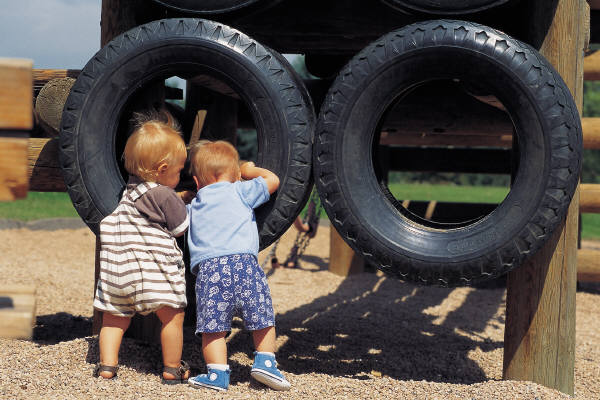
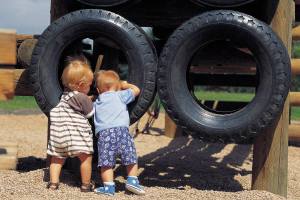 As a mother of a five year old boy, I find that I frequent the local parks quite a bit. In fact, it is probably my most visited location besides the grocery store since my son’s birth. In spending a lot of time at playgrounds, I’ve discovered a true writing treasure- the ability to study a wide variety of characters and the basic human condition in just an hour or two of doing my most important job of all- “being mom”.
Want to get a good glance at an array of human behaviors from antagonistic, insecure, mischievous to friendly, confident, and intuitive? Just take a trip to the park, and let this small playground world give a glimpse into the bigger world. It’s a cast of characters waiting to be plucked for a story or novel, or just to be studied to understand reactions to certain situations. It’s humanity raw with all the complexities of adulthood stripped away. It’s the simplicity of behaviors at the most infant stage. Friendships are forged in a matter of one slide down the big red twisty slide. Or witness that awkward moment when no one can agree on what to play, or personalities clash like a display of colorful fireworks. It’s all there to see for anyone willing to watch. It’s where priceless moments are created and children learn to belong, or just find out how annoying some kids can really be. But the kids aren’t the only illuminating presences at the park. Some of the most interesting playground lurkers are the parents themselves.
-
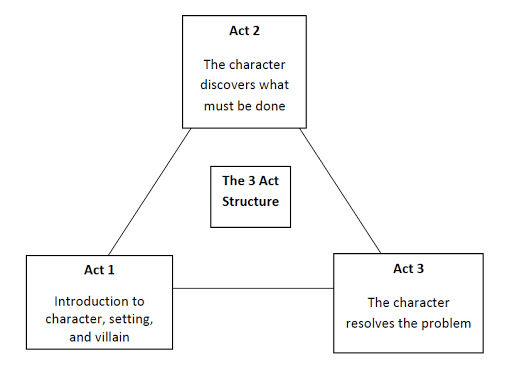
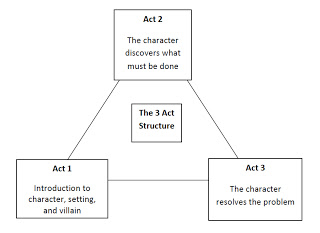 In the recent writing workshop with Johnathan Maberry we talked a lot about the 3 acts of the story structure. This workshop made me realize once again how helpful this little tool can be when plotting out a story. Most stories can be broken down to this basic structure and it is something to use as a guide when plotting out your own story. Let’s break down the 3 acts and see what each act entails. I’ll also use an example of the Wizard of Oz to show this breakdown.
ACT ONE it is the introduction of characters and setting, possibly a glance at the villain and an introduction to the threat within the story.
This is where all the reader needs to become familiar with the character and become invested in the story that is unfolding. The world needs to be established
END OF ACT ONE happens when the character reaches the point of no return. He or she is propelled or pushed forward into the story and the character’s path is set
Example: Dorthy is introduced into the story. We see that she is a young girl who is spoiled and untested. A tornado whisks her away to the strange land of Oz.
ACT TWO this middle act usually takes up about 50 percent of the story as the character is further developed and the stakes become clear.
This is where relationship building happens between the main character and the supporting characters, and it’s were subplots usually take place (for novels or longer short stories).
END OF ACT TWO happens when the character realizes what must be done to resolve the problem that he or she has been faced with.
Example: Once in Oz, Dorthy meets Glinda. She tells Dorthy what must be done to go home and Dorthy sets out on her mission to find the Wizard of Oz.
ACT THREE is when the character finds the resolution to the problem.
This is where the character rises above everything in his or her path to be the story’s champion.
END OF ACT THREE happens once the character resolves the main issue of the story either for the good or bad.
Example: Dorthy defeats the wicked witch and finds the Wizard of Oz.
Now it’s true that the 3 act applies mostly to screen plays, but it can also be applied to most stories as well. Sometimes the acts are expanded to create more than three, and sometimes the first act is combined with the second act in stories, but using the three acts can help to show the skeleton of a story. It’s a good simple way to make sure a story is on the right track to creating a coherent and dynamic piece of work. If you haven’t already, can you break down your current piece of work and find the 3 acts of its structure?
There are also those who argue that a 3 act structure can’t show all the elements of a story that it really takes a 5 act structure. This type of structure just breaks down the story even further with exposition, rising action, climax, falling action and the denoucement or resolution. You can read more about in a post that I wrote a while ago about Freytag’s 5 act structure.
-
This post is another result of one of Michael Knost classes. This most recent class I took was all about flashbacks (and backstory, but that’s a different post). I found a few “light bulb” moments in the class that just had to share, but this post really is only the tip of the iceberg of what I learned.
The most important thing to remember… Flashbacks should not be used unless there is absolutely no other way the story can be told. Flashbacks carry a built-in disadvantage to even the best of written stories, because it stops the story. A flashback is about something that has already happened. It’s over and done with so the flashback lacks immediacy.
There are 3 advantages to having a flashback in a story…
- helps establish character motives
- fills in events of how the original current story came about
- fills in critical information that happened years earlier
If a story must hold a flashback there are 3 ways to maximize the advantages of a flashback…
- Time travel done right
Every flashback should follow a strong current story scene. Flashbacks should never start a scene. Before dropping the past onto the reader, the current story must be established first; otherwise, the reader will become invested in the flashback and not care about the current story. - Orient the reader at the start of the flashback in time and space
Make sure that it is made clear that the story is moving backwards in time. Give a clear indication at the very beginning what is happening to avoid throwing the reader into confusion and frustration. There’s nothing worse than reading a story and not being able to figure out where in space and time the story is supposed to be taking place. - Use verbal tense conventions to guide the reader in and out of the flashback
Conventions through verbal tense can be used to “signal” both the start and end of a flashback. This sort of thing is subtle and may not be noticed by the conscious mind of the reader, but is very effective in guiding the reader properly in and out of flashbacks. This is the best way to help eliminate flashback confusion.
Example: Let’s say you are writing a story in pasted tense (that’s my preferred style of writing). That means the first few verbs (usually the first 5 verbs) used in the flashback should be perfect past tense (had, had been). Then switch back to pasted tense. When you are ready to end the flashback switch back to perfect past tense for another 5 or so verbs. Once back in the current story, you return to using past tense verbs.
Are you confused yet? Here’s a shortened version I made to help me keep it straight…
current story (past tense) + beginning of flashback (perfect past tense 5 verbs) + middle of flashback (paste tense) + end of flashback (perfect past tense 5 verbs) + return to current story (past tense)
What if a story is written in present tense? Then you would use past tense verbs instead of perfect past tense verbs.
Here’s an example of a switch from a present tense story to flashback from Suzanne Collin’s Hunger Games...
“We don’t speak. Our real interaction happened years ago. He’s probably already forgotten it. But I haven’t and I know I never will…
It was the worst time. My father had been killed in the mine accident three months earlier in the bitterest January anyone could remember. The numbness of his loss had passed, and the pain would hit me out of nowhere, doubling me over, racking my body with sobs. Where are you? I would cry out in my mind. Where have you gone? Of course there was never any answer.”If flashbacks are used, it should be done sparingly. Flashbacks should never occur back to back. Strong scenes should separate each flashback scene.
There is an acceptable form of story that uses flashbacks to tell a story and that would be a “frame story”. This story can be any length (from short story to novel), which begins after all the action is over. The protagonist or author announces that they are going to tell a story and may even give out the entire outcome at the beginning of the story. Example of this type of stories are True Grit by Charles Portis and Water for Elephants Sara Gruen.
Update June 26 2019: I wrote this blog post many years ago, since then my position on flashbacks have changed. I do believe flashbacks can be used as often as a person wants within reason. I published my first book Blood Feud and it has numerous flashbacks that, in my opinion, work very well. But I spent a lot of time trying to get them right and making sure they were necessary to move the story. Sometimes in order to move forward and bring more depth to a story flashbacks can be quite useful.
It is also worth mentioning here too, that just because a writer gives you advice on how writing should be, does not mean it has to be. Use your best judgement. Every writer and every story are unique. Know what is true for you as a writer, and let the rest go. Happy Writing!
 Cynthia D. Griffin